
It was a Tuesday. 6:43 PM. I was standing in my kitchen in my work clothes, shoes still on, staring into my open refrigerator like it was a broken television. I had been on keto for eleven days. I had been meaning to be on keto for about four months.
My phone was open to three different tabs — a keto casserole recipe, a Reddit thread about net carbs in butternut squash, and a DoorDash menu. I was Googling “is rotisserie chicken keto?” for the second time that week. I already knew the answer. I just couldn’t decide what to do with the information.
Twenty minutes later, I ordered pizza. Not because I didn’t care. Not because I wasn’t motivated. But because my brain — which had already made approximately 35,000 decisions that day — simply had nothing left for dinner.

🗓️
Sound familiar? If your keto efforts keep unraveling after dark, you’re not weak — you’re depleted. Our 30-Day Keto Meal Plan for Busy Beginners eliminates every dinner decision in advance. Download it here — free for a limited time →
That night, after the pizza box was on the coffee table and the guilt had settled in, I finally stopped blaming my willpower. I started blaming the system — or rather, the total absence of one. I had been trying to eat keto with zero structure, treating every meal like a puzzle to solve from scratch. No wonder I was failing. I was asking an exhausted brain to make hard choices at its most depleted hour.
📦
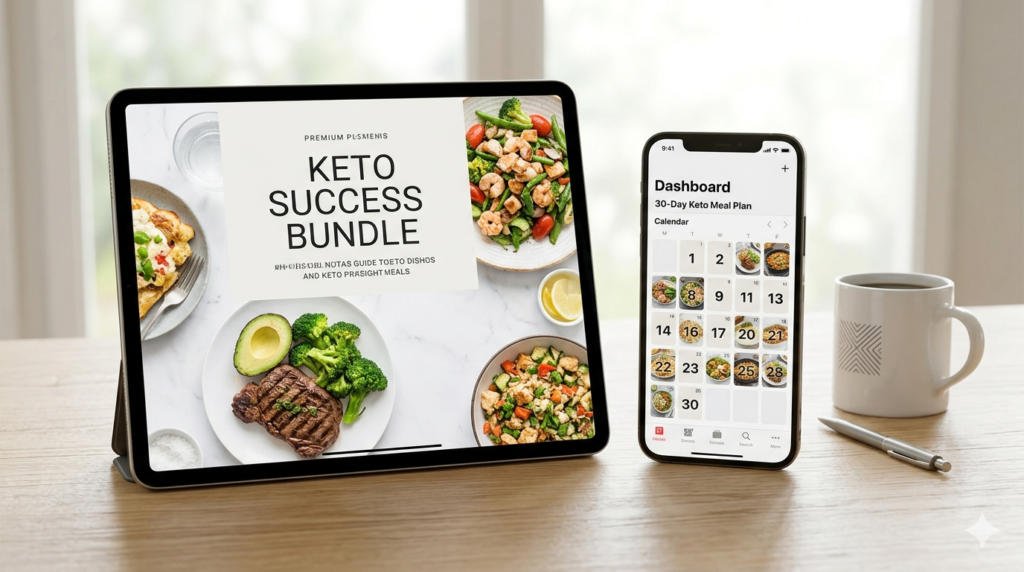
Ready to overhaul the whole approach? The Keto Success Bundle includes the meal plan, a shopping list system, and macro guides — everything to remove the mental load at once. Get the Bundle here →
The next morning, I decided to run a 30-day experiment. For one month, I would make zero dinner decisions in real time. Every meal would be decided in advance, on Sunday, by a calmer and more rational version of myself. The results changed how I eat — and how I think about willpower altogether. Here’s everything I learned, including the science that explains why your best keto intentions keep collapsing at dinnertime, and the exact system I used to fix it.
✅
Don’t want to build the system yourself? You don’t have to. Grab the 30-Day Keto Meal Plan — 30 days of pre-decided, budget-friendly dinners, built for busy people. Click to access it now →
· · ·
The Science of Decision Fatigue (And Why Keto Is Especially Brutal)
Decision fatigue is not a productivity blog buzzword. It is a documented psychological phenomenon with real neurological underpinnings — first studied by social psychologist Roy Baumeister and his colleagues in the late 1990s, and rigorously explored ever since.
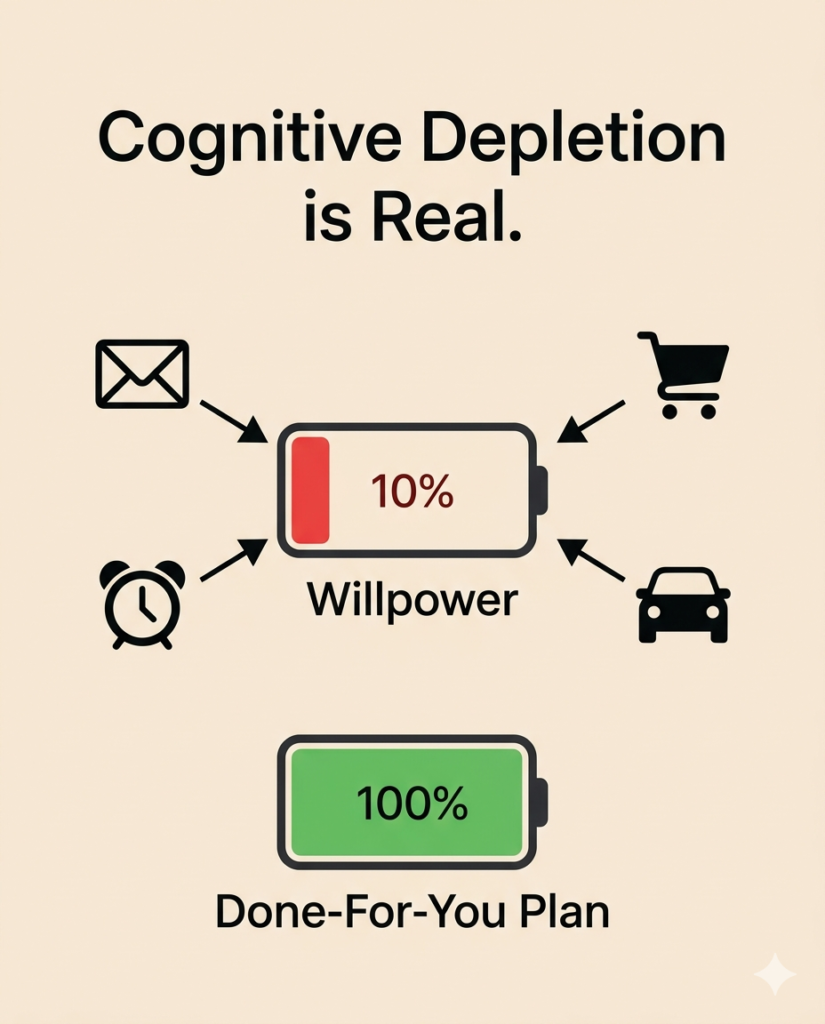
The core idea is this: every decision you make draws from the same finite pool of cognitive resources. The more decisions you make, the lower-quality your subsequent choices become. Your brain doesn’t collapse dramatically — it quietly degrades. And its preferred escape route is almost always the path of least resistance: the familiar, the easy, the comfortable. Which, for most of us, is not a ketogenic meal.
35,000Decisions made by an average adult per day
221Of those decisions are about food alone
6 PMThe hour when willpower is statistically at its lowest
A famous 2011 study of Israeli parole judges found that early-morning approval rates hovered around 65% — and dropped to nearly zero right before lunch, only to recover after the break. The judges weren’t becoming harsher. They were becoming depleted. Their brains defaulted to “no” because “no” required less cognitive energy than a nuanced evaluation.
Your brain does exactly the same thing at 6:30 PM when you open the fridge. “What should I make for dinner?” is not a simple question. It is actually a cascade of smaller questions: What do I have? What’s expiring? What fits my macros? How long do I have? Will anyone else eat this? Is that chicken still good? Every one of those sub-questions burns glucose and willpower.
Why Keto Specifically Amplifies Decision Fatigue
Standard dietary advice is permissive: eat less, move more, avoid junk. The cognitive load is low because the rules are vague. Keto is the opposite. It is a precision diet with hard macro targets, a restricted ingredient list, and constant net-carb arithmetic. It demands more from your decision-making machinery — at the exact moment of day when that machinery has the least to give.
- Every meal is a math problem. Net carbs, fat ratios, protein ceilings — it’s a lot to calculate while also being hungry and tired.
- The forbidden foods are everywhere. Bread, pasta, rice, fruit — the most convenient foods in any American household are off-limits. Substitutes require planning.
- Social friction is real. Deciding whether to eat keto at a work lunch, a birthday party, or a takeout situation burns extra cognitive fuel.
- The stakes feel higher. Because keto requires staying in ketosis, one “wrong” decision feels catastrophic — adding emotional weight on top of cognitive load.
Expert Tip
Stanford psychologist Kelly McGonigal notes that willpower is a “muscle” that fatigues with use but recovers with rest. The strategic implication: make your hardest dietary decisions first thing in the morning or the night before — never in real time when hunger is active. Pre-commitment is one of the most powerful behavioral tools we have.
This is why so many people succeed at keto through Monday — and then unravel by Thursday. It isn’t a character flaw. It’s a design flaw in how they’re approaching the diet. They’re fighting biology with willpower instead of removing the need for willpower altogether.
· · ·
The Three Hidden Reasons Keto Fails (That Nobody Talks About)
The keto community loves to debate macros, fasting windows, and electrolytes. But in my experience — and in the experience of most people who’ve cycled on and off keto for years — the failures are almost never biochemical. They’re structural and psychological.
Failure Mode #1: The “What’s For Dinner?” Death Spiral
You have no plan. You get home late. You open the fridge and nothing is prepped. You pull out your phone and start looking up recipes. Twenty minutes of searching, and you’re either ordering in or raiding the pantry for whatever requires zero effort. We’ve all been here. The solution isn’t more motivation — it’s eliminating the question entirely.
Failure Mode #2: The Grocery Store Ambush
You go to the grocery store without a list. You buy what looks good. You get home and realize you have zucchini, rotisserie chicken, heavy cream, and no coherent plan for how these items relate to each other. You do this for three days until something expires, and then you feel guilty about the food waste on top of the diet failure.
Failure Mode #3: The Weekend Collapse
Monday through Friday, the structure of work provides a kind of meal rhythm. But Saturday hits — no schedule, no routine, lots of free time and social temptation — and the entire system evaporates. Without pre-decided meals and a stocked kitchen, weekends become the graveyard of keto streaks.
Expert Tip
Behavioral economists call this the “planning fallacy” — we consistently overestimate our future discipline and underestimate the power of our environment. The fix isn’t trying harder. It’s changing the environment so that the easy choice and the healthy choice become the same choice.
“You don’t rise to the level of your goals. You fall to the level of your systems.” — James Clear, Atomic Habits
· · ·
The Solution: The 30-Day Decision-Free Keto System
Here is what I actually did, and what worked — not as an inspirational anecdote, but as a repeatable system anyone can follow. The principle is simple: batch all food decisions into one Sunday morning session, so that the rest of the week requires zero cognitive effort around eating.
Step 1 — Commit to a Pre-Decided Meal Framework
Stop treating meals as things you “figure out” in real time. Commit to having 5 weekday dinners planned by Sunday night. This single shift — from reactive to proactive — is responsible for more keto success than any macro tweak I’ve ever seen.
Your Sunday decision session should take no more than 30 minutes. You review your meal plan, write your shopping list, and make exactly one grocery run. Everything else during the week is execution, not decision-making.
Step 2 — Reduce Your Dinner Rotation to 10 Core Meals
You do not need variety. You need reliability. Research on habit formation consistently shows that dietary adherence improves when meals are predictable, not novel. Identify 10 keto dinners your household genuinely enjoys — meals that are simple, budget-friendly, and macro-appropriate — and rotate through them.
- Sheet pan chicken thighs with broccoli and garlic butter
- Ground beef taco bowls (cauliflower rice base)
- Baked salmon with asparagus and lemon aioli
- Egg roll in a bowl (no wrapper, all flavor)
- Zucchini noodles with meat sauce
- Creamy tuscan sausage skillet
- Stuffed bell peppers with ground turkey and cheese
- Shrimp stir-fry with low-carb vegetables
- Keto chili (batch-cook and freeze)
- Pork tenderloin with green beans and compound butter
Expert Tip
Nutritional psychiatrist Dr. Uma Naidoo notes that decision fatigue is worsened by blood sugar volatility — which means that failing to eat keto actually makes it harder to decide to eat keto the next time. The virtuous cycle runs in reverse too: stable blood sugar from clean keto eating reduces decision fatigue, making future adherence easier. Getting through the first 14 days is the hardest part.
Step 3 — Build a Non-Negotiable Emergency Protocol
Even the best meal plans encounter chaos. Your meeting runs long. The kids have an activity. Your spouse forgot to defrost the chicken. For these moments, you need a zero-decision emergency protocol — two or three “always available” keto options that require no planning and no thought.
- Rotisserie chicken + bag salad + olive oil: 8 minutes, under $12, fully keto.
- Scrambled eggs with cheese and avocado: 5 minutes, $3, zero carbs.
- Canned tuna + mayo + cucumber slices: 3 minutes, $2, reliable protein hit.
Keep the ingredients for these meals in stock at all times. These are your circuit breakers — the things that prevent an “I have nothing to eat” moment from becoming a DoorDash moment.
Skip the Setup. Steal My 30-Day Plan.
The 30-Day Keto Meal Plan for Busy Beginners gives you exactly this system — pre-decided meals, shopping lists, emergency protocols, and macro guides — so you can start your decision-free month this weekend.Yes, I Want the 30-Day Keto Meal Plan →

Step 4 — Leverage the “One Decision Unlocks Everything” Rule
Here is the cognitive hack at the heart of this system: making one decision in advance — “I’m having sheet pan chicken on Wednesday” — eliminates approximately 12 downstream decisions. You don’t have to decide what to cook, what to buy, whether it’s keto, how long it takes, or whether you have the ingredients. One decision. Zero execution friction.
This is the same principle used by successful people who eat the same lunch every day. Barack Obama famously limited his clothing choices to reduce decision fatigue for more important matters. Mark Zuckerberg’s gray t-shirts are the same idea. You don’t have to be a tech billionaire to apply it — you just have to apply it to dinner.
Step 5 — Front-Load the Month With Simplicity
For the first two weeks, cook nothing elaborate. Your only goal is adherence, not culinary excellence. Sheet pans, one-pan skillets, and slow cooker dumps are your best friends. Save the impressive keto cheesecakes and fathead pizza dough for week three, when you’re in ketosis, your energy is high, and the habit has started to cement itself.
Expert Tip
A 2022 study in Appetite journal found that meal planning was consistently associated with higher diet quality, greater food variety, and lower obesity rates — independent of income level. The act of planning itself, not just the plan’s content, appears to improve dietary outcomes. Your Sunday session is doing more work than you think.
· · ·
USA-Inspired Budget Hacks: Eating Keto for Under $10 a Day
One of the most persistent myths about ketogenic eating is that it’s expensive. And if you’re buying grass-fed beef, wild-caught salmon, and organic everything from Whole Foods every week, it is expensive. But that is a choice, not a requirement. Here’s how real budget-conscious Americans eat clean keto without breaking the bank — using the specific pricing landscape of American grocery retail in 2026.
Walmart / Neighborhood Market
Great Value heavy whipping cream ($2.97/pint), pork shoulder roasts ($1.49/lb in many markets), rotisserie chickens ($4.98 — split across 3 meals).
Costco / Sam’s Club
Bulk chicken thighs ($1.19/lb), huge packs of ground beef (freeze in 1lb portions), Kirkland canned tuna (14 cans for ~$18), large blocks of cheddar cheese.
Aldi
The keto secret weapon. Eggs ($2.19/dozen), butter ($2.79/lb), broccoli bags ($1.19), bacon ($3.49/12oz). ALDI runs targeted weekly specials on meat — check the “ALDI Finds” flyer every Wednesday.
Kroger / Fred Meyer / Ralphs
Download the app for digital coupons. Chicken drumsticks frequently go on markdown to $0.79/lb. The deli counter often has discounted rotisserie or prepared meats near close.
Target (Pickup Orders)
Order online for 5% off with RedCard. Good Good brand almond butter, unsweetened coconut milk, and pork rinds (great keto snack at $1.99/bag) are reliably priced well.
Dollar General / Dollar Tree
Overlooked keto resource. Canned fish (sardines, tuna, mackerel), full-fat cream cheese, and pork rinds at excellent prices. Not every location, but worth checking.
The $10/Day Keto Day Template (Real Numbers)
- Breakfast: 3 scrambled eggs + 2 strips bacon + black coffee — ~$1.40
- Lunch: Tuna salad with mayo on cucumber + cheese slices — ~$2.20
- Dinner: Chicken thigh + roasted broccoli + garlic butter — ~$3.80
- Snacks: Pork rinds + string cheese + handful of pecans — ~$1.60
- Total: ~$9.00/day
Expert Tip
The single highest-ROI keto budget move is buying whole chickens instead of boneless breasts. A $6 whole chicken yields roasted meat for dinner, carcass-made bone broth (a keto staple), and enough leftover protein for two lunches. That’s roughly 9 servings from one $6 investment. Learn to break down a chicken — it takes 8 minutes with a sharp knife and a YouTube video.
The key insight from a year of budget keto tracking: fat is cheap. The keto macros that most people worry about — high fat — are actually the most economical to achieve. Butter, eggs, heavy cream, pork belly, chicken thighs with skin, and canned sardines are all among the most affordable foods in any American grocery store. You don’t need expensive steak every night. You need smart sourcing.
· · ·
What Happened After 30 Days
By day 12, I stopped feeling the dinner dread. By day 19, I noticed I had mental bandwidth at 7 PM that I had forgotten I possessed — bandwidth for reading, for actual conversations with my family, for creative work. By day 30, the behavior was automatic. Sunday planning felt like maintenance, not effort.
I lost 11 pounds. But that almost felt secondary. The bigger shift was psychological: I stopped believing that healthy eating was primarily a willpower problem. It’s a design problem. And once you redesign the environment — once you pre-commit, pre-decide, and pre-shop — the willpower question barely comes up.
I have now been doing this for 14 months. The system has outlasted more keto “streaks” than I can count from my previous years of trying. It works not because I became a different person, but because I stopped requiring myself to be one.
“You don’t need more discipline. You need fewer decisions standing between you and your goals.”
Ready to Stop Thinking About Dinner?
The 30-Day Keto Meal Plan for Busy Beginners gives you a complete, pre-decided meal framework — built for real budgets, real schedules, and real life. No more 6 PM paralysis. No more DoorDash guilt. Just open, cook, eat.
Get the 30-Day Meal Plan →Or grab the full Keto Success Bundle
Both come with a 30-day satisfaction guarantee. Try it for a month. If it doesn’t simplify your life, we’ll refund every